

Anandharamakrishnan C. Скачать все книги 2 Количество книг



Жанр в блоке книги Мукомольное Производство
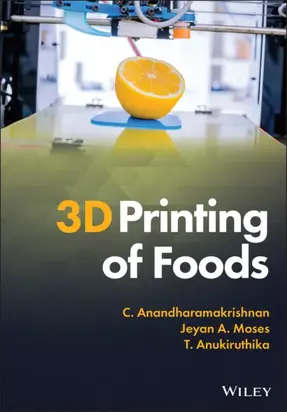
3D Printing of Foods < Explore the fascinating realm of 3D food printing and its applications In 3D Printing of Foods , a team of distinguished researchers delivers a comprehensive and eye-opening exploration of the rapidly developing field of 3D food printing. In the book, the authors offer readers an examination of “food printability,” the foundation of 3D food printing. They discuss the enormous research gap in the subject that remains to be addressed and envisage a robust discipline in which food processing techniques, combined with 3D food printing, gives rise to a range of synergistic applications. In addition to treatments of safety challenges and research requirements, the book tackles food industry market trends and consumer preferences, as well as the globalization of printed foods and consumer perception of 3D printed foods. 3D Printing of Foods also explores the integration of electrohydrodynamic processes and encapsulation with 3D food printing. Readers will also find: Thorough introductions to 3D printing technology, 3D printing approaches, and food components and their printability In-depth examinations of the factors affecting the printability of foods, printability and techniques, and natively printable foods Practical discussions of pre-processing of non-printable foods and alternative ingredients used in food printing Comprehensive explorations of 4D printing technology and the applications of 3D food printing technology Perfect for 3D printing professionals and enthusiasts, as well as food scientists, 3D Printing of Foods is an indispensable resource for anyone interested in a one-stop resource addressing this cutting-edge technology with nearly limitless potential.

Жанр в блоке книги Мукомольное Производство
Spray drying is a well-established method for transforming liquid materials into dry powder form. Widely used in the food and pharmaceutical industries, this technology produces high quality powders with low moisture content, resulting in a wide range of shelf stable food and other biologically significant products. Encapsulation technology for bioactive compounds has gained momentum in the last few decades and a series of valuable food compounds, namely flavours, carotenoids and microbial cells have been successfully encapsulated using spray drying. Spray Drying Technique for Food Ingredient Encapsulation provides an insight into the engineering aspects of the spray drying process in relation to the encapsulation of food ingredients, choice of wall materials, and an overview of the various food ingredients encapsulated using spray drying. The book also throws light upon the recent advancements in the field of encapsulation by spray drying, i.e., nanospray dryers for production of nanocapsules and computational fluid dynamics (CFD) modeling. Addressing the basics of the technology and its applications, the book will be a reference for scientists, engineers and product developers in the industry.

10 Количество книг
2 Количество книг
1 Количество книг
