

Beck Ulrich Скачать все книги 11 Количество книг


Жанр в блоке книги Социология
In this new book, Ulrich Beck develops his now widely used concepts of second modernity, risk society and reflexive sociology into a radical new sociological analysis of the cosmopolitan implications of globalization. Beck draws extensively on empirical and theoretical analyses of such phenomena as migration, war and terror, as well as a range of literary and historical works, to weave a rich discursive web in which analytical, critical and methodological themes intertwine effortlessly. Contrasting a ‘cosmopolitan vision’ or ‘outlook’ sharpened by awareness of the transformative and transgressive impacts of globalization with the ‘national outlook’ neurotically fixated on the familiar reference points of a world of nations-states-borders, sovereignty, exclusive identities-Beck shows how even opponents of globalization and cosmopolitanism are trapped by the logic of reflexive modernization into promoting the very processes they are opposing. A persistent theme running through the book is the attempt to recover an authentically European tradition of cosmopolitan openness to otherness and tolerance of difference. What Europe needs, Beck argues, is the courage to unite forms of life which have grown out of language, skin colour, nationality or religion with awareness that, in a radically insecure world, all are equal and everyone is different.
Жанр в блоке книги Социология
Europe is Europe’s last remaining realistic political utopia. But Europe remains to be understood and conceptualized. This historically unique form of international community cannot be explained in terms of the traditional concepts of politics and the state, which remain trapped in the straightjacket of methodological nationalism. Thus, if we are to understand cosmopolitan Europe, we must radically rethink the conventional categories of social and political analysis. Just as the Peace of Westphalia brought the religious civil wars of the seventeenth century to an end through the separation of church and state, so too the separation of state and nation represents the appropriate response to the horrors of the twentieth century. And just as the secular state makes the exercise of different religions possible, so too cosmopolitan Europe must guarantee the coexistence of different ethnic, religious and political forms of life across national borders based on the principle of cosmopolitan tolerance. The task the authors have set themselves in this book is nothing less than to rethink Europe as an idea and a reality. It represents an attempt to understand the process of Europeanization in light of the theory of reflexive modernization and thereby to redefine it at both the theoretical and the political level. This book completes Ulrich Beck’s trilogy on ‘cosmopolitan realism’, the volumes of which complement each other and can be read independently. It is essential reading for anyone interested in the key social and political developments of our time.

Жанр в блоке книги Социология
Twenty years ago Ulrich Beck published Risk Society, a book that called our attention to the dangers of environmental catastrophes and changed the way we think about contemporary societies. During the last two decades, the dangers highlighted by Beck have taken on new forms and assumed ever greater significance. Terrorism has shifted to a global arena, financial crises have produced worldwide consequences that are difficult to control and politicians have been forced to accept that climate change is not idle speculation. In short, we have come to see that today we live in a world at risk. A new feature of our world risk society is that risk is produced for political gain. This political use of risk means that fear creeps into modern life. A need for security encroaches on our liberty and our view of equality. However, Beck is anything but an alarmist and believes that the anticipation of catastrophe can fundamentally change global politics. We have the opportunity today to reconfigure power in terms of what Beck calls a 'cosmopolitan material politics’. World at Risk is a timely and far-reaching analysis of the structural dynamics of the modern world, the global nature of risk and the future of global politics by one of the most original and exciting social thinkers writing today.
Жанр в блоке книги Социология
In this new book, Ulrich Beck and the journalist Johannes Willms engage in a series of accessible conversations that reveal and explore the key elements in Beck’s thought. Ulrich Beck, one of the most important and influential contemporary social thinkers, reveals and expands his work in a series of conversations with journalist Johannes Willms. These conversations shed new light onto the major themes in Beck’s work and provide an insight into some of the commitments and beliefs that they rest upon. Includes new thinking on the risk society and on globalisation, themes that have put him at the forefront of contemporary debates. Witten in a clear and lucid way and thus ideal for anyone seeking to come to grips with Beck’s work.
Жанр в блоке книги Социология
This brilliant new book by one of Europe's leading social thinkers throws light on the global power games being played out between global business, nation states and movements rooted in civil society. Beck offers an illuminating account of the changing nature of power in the global age and assesses the influence of the ever-expanding counter-powers. The author puts forward the provocative thesis that in an age of global crises and risks, a politics of «golden handcuffs» – the creation of a dense network of transnational interdependencies – is exactly what is needed in order to regain national autonomy, not least in relation to a highly mobile world economy. It is imperative that the maxim of nation-based realpolitik – that national interests have necessarily to be pursued by national means – be replaced by the maxim of cosmopolitan realpolitik. The more cosmopolitan our political structures and activities, Beck suggests, the more successful they will be in promoting national interests, and the greater our individual power in this global age will be.
Жанр в блоке книги Социология
In this important book, Ulrich Beck – one of the leading social thinkers in Europe today – examines how work has become unstable in the modern world and presents a new vision for the future. Beck begins by describing how the traditional work society, with its life-long job paths, is giving way to a much less stable world in which skills can be suddenly devalued, jobs obliterated, welfare cover reduced or eliminated. The West would appear to be heading towards a social structure of ambiguity and multiple activity that has hitherto been more characteristic of the developing world. But what appears to be the end of traditional working practices can also be seen as an opportunity to develop new ideas and models for work in the twenty-first century. Beck's alternative vision is centred on the concept of active citizens democratically organized in local, and increasingly also regional or transnational, networks. Against the threat of social exclusion, everyone can and must have a right to be included in a new definition and distribution of work. This will involve constant movement between formal employment (with a major reduction in working hours) and forms of self-organized artistic, cultural and political 'civil labour', providing equal access to comprehensive social protection. The aim must be to turn insecurity around, so that it becomes a positive and enriching discontinuity of life. Drawing on his earlier work on risk and reflexive modernization, The Brave New World of Work is also closely linked to his studies on globalization and individualization. These processes are part of the same challenge upon which a politics of modernity must now base itself. Not only the future of work, but also the very survival of democracy and the welfare state will depend on the development of a newly committed and 'multi-active' transnational citizenship. This book will be of great interest to second- and third-year students in sociology, politics, geography and the social sciences generally. It will also appeal to a broader audience interested in the issues and debates surrounding the changing nature of work.
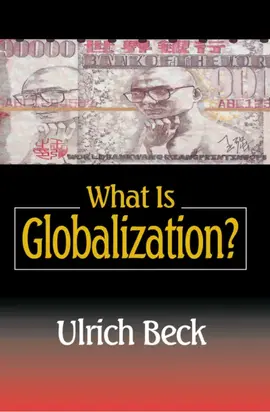
Жанр в блоке книги Политология
This important new book offers an engaging and challenging introduction to the thorny paths of the globalization debate.
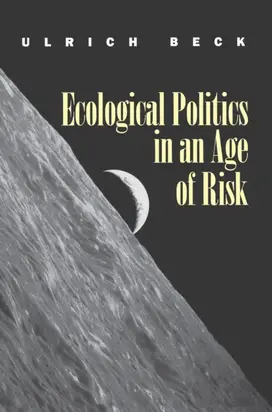
Жанр в блоке книги Зарубежная Образовательная Литература
Ecological Politics in and Age of Risk by Ulrich Beck is an original analysis of ecological politics as one part of a renewed engagement with the domain of sub-politics.
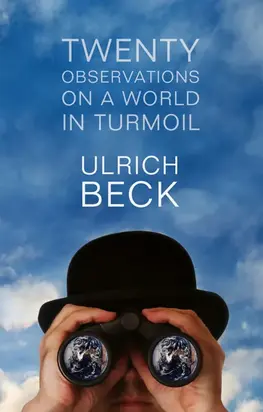
Жанр в блоке книги Политология
Translated by Ciaran Cronin. The world is a state of turmoil. From the financial crisis to the chaos in the eurozone, from the Arab uprisings to protests in Athens, Barcelona, New York and elsewhere, many of the familiar frameworks are collapsing and we have to find new ways to orient ourselves in a world undergoing rapid change. Of course, it is necessary for political leaders to address local issues and react to people s specific demands, but without a cosmopolitan outlook, such a reaction is likely to be inadequate. Ulrich Beck s Twenty-one Observations on a World in Turmoil is a demonstration of cosmopolitan politics in practice. It is more than a mirror: it is a magnifying glass that brings into focus the processes that are transforming our world and highlights the great challenges we face today. Global domestic politics , the concept introduced and developed by Beck, is much more than a political theory, a philosophical utopia (or dystopia), a governance programme or a mental state: it is the reality of our times. Beck turns the argument that global domestic politics is an unrealistic ideology on its head, arguing that it is the proponents of the national who are the idealists. They view reality through the obsolete lenses of the nation-state and thus cannot see the profound global changes that are transforming our reality. Global domestic politics is therefore a perspective, a political reality and a normative idea. And it is the critical theory of our times since it challenges the most profound truths which we hold dear: the truths of the nation.

Жанр в блоке книги Семейная Психология
Love and family life in the global age: grandparents in Salonika and their grandson in London speak together every evening via Skype. A U.S. citizen and her Swiss husband fret over large telephone bills and high travel costs. A European couple can finally have a baby with the help of an Indian surrogate mother. In their new book, Ulrich Beck and Elisabeth Beck-Gernsheim investigate all types of long-distance relationships, marriages and families that stretch across countries, continents and cultures. These long-distance relationships comprise so many different forms of what they call ‘world families’, by which they mean love and intimate relationships between individuals living in, or coming from, different countries or continents. In all their various forms these world families share one feature in common: they are the focal point in which different aspects of the globalized world become embodied in the personal lives of individuals. Whether they like it or not, lovers and relatives in these families find themselves confronting the world in the inner space of their own lives. The conflicts between the developed and developing worlds come to the surface in world families- they acquire faces and names, creating confusion, surprise, anger, joy, pleasure and pain at the heart of everyday life. This path-breaking book will appeal to a wide readership interested in the changing character of love in our times.

Жанр в блоке книги Зарубежная Деловая Литература
The euro crisis is tearing Europe apart. But the heart of the matter is that, as the crisis unfolds, the basic rules of European democracy are being subverted or turned into their opposite, bypassing parliaments, governments and EU institutions. Multilateralism is turning into unilateralism, equality into hegemony, sovereignty into the dependency and recognition into disrespect for the dignity of other nations. Even France, which long dominated European integration, must submit to Berlin’s strictures now that it must fear for its international credit rating. How did this happen? The anticipation of the European catastrophe has already fundamentally changed the European landscape of power. It is giving birth to a political monster: a German Europe. Germany did not seek this leadership position – rather, it is a perfect illustration of the law of unintended consequences. The invention and implementation of the euro was the price demanded by France in order to pin Germany down to a European Monetary Union in the context of German unification. It was a quid pro quo for binding a united Germany into a more integrated Europe in which France would continue to play the leading role. But the precise opposite has happened. Economically the euro turned out to be very good for Germany, and with the euro crisis Chancellor Angela Merkel became the informal Queen of Europe. The new grammar of power reflects the difference between creditor and debtor countries; it is not a military but an economic logic. Its ideological foundation is ‘German euro nationalism’ – that is, an extended European version of the Deutschmark nationalism that underpinned German identity after the Second World War. In this way the German model of stability is being surreptitiously elevated into the guiding idea for Europe. The Europe we have now will not be able to survive in the risk-laden storms of the globalized world. The EU has to be more than a grim marriage sustained by the fear of the chaos that would be caused by its breakdown. It has to be built on something more positive: a vision of rebuilding Europe bottom-up, creating a Europe of the citizen. There is no better way to reinvigorate Europe than through the coming together of ordinary Europeans acting on their own behalf.

6 Количество книг
2 Количество книг
2 Количество книг
