

Adorno Theodor W. Скачать все книги 24 Количество книг



Жанр в блоке книги История Философии
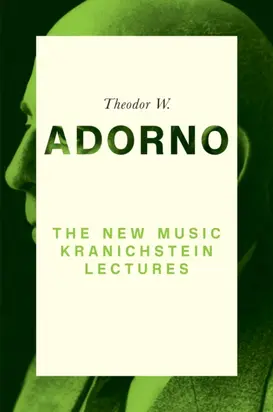
A year after the end of the Second World War, the first International Summer Course for New Music took place in the Kranichstein Hunting Lodge, near the city of Darmstadt in Germany. The course, commonly referred to later as the Darmstadt course, was intended to familiarize young composers and musicians with the music that, only a few years earlier, had been denounced as degenerate by the Nazi regime, and it soon developed into one of the most important events in contemporary music. Having returned to Germany in 1949 from exile in the United States, Adorno was a regular participant at Darmstadt from 1950 on. In 1955 he gave a series of lectures on the young Schoenberg, using the latter’s work to illustrate the relation between tradition and the avant-garde. Adorno’s three double-length lectures on the young Schoenberg, in which he spoke as a passionate advocate for the composer whom Boulez had declared dead, were his first at Darmstadt to be recorded on tape. The relation between tradition and the avant-garde was the leitmotif of the lectures that followed, which continued over the next decade. Adorno also dealt in detail with problems of composition in contemporary music, and he often accompanied his lectures with off-the-cuff musical improvisations. The five lecture courses he gave at Darmstadt between 1955 and 1966 were all recorded and subsequently transcribed, and they are published here for the first time in English. This volume is a unique document on the theory and history of the New Music. It will be of great value to anyone interested in the work of Adorno and critical theory, in German intellectual and cultural history, and in the history of modern music.

Жанр в блоке книги Документальная Литература
La filosofía, según declara el inicio de Dialéctica negativa, sigue en vida porque se perdió el instante de su realización. Debía dejar de interpretar el mundo y pasar a cambiarlo, y no lo logró. Esto abre al menos dos preguntas, que rondarán las presentes lecciones –traducidas por primera vez al español– tanto como el libro llamado Dialéctica negativa, que Adorno terminaba de redactar por entonces, en 1966. ¿Cómo es posible aún la filosofía? ¿Cómo concebirla tras aquel fracaso de hacerla realidad? Las discusiones serán entonces con Marx, con su maestro Hegel y con Kant; tres filósofos que siempre funcionaron como horizonte teórico y dialógico de Adorno. También contra los enemigos filosóficos establecidos ya desde un principio: el positivismo, la ontología, el irracionalismo, la fenomenología. Esta filosofía aún posible llevará el nombre de crítica o, si se quiere, de dialéctica. Pero no será la heredada de Hegel, aquella que pactaba con lo real y postulaba lo absoluto, y que entronizaba el concepto sobre la cosa. Esta dialéctica ha de ser negativa. Así, se resguardará de convertirse en la afirmación de lo que hay y luchará por el salvataje de lo particular. Se volverá oposición, y esto en más de un sentido: contra el todo social y contra el todo del sistema filosófico, que se copertenecen. Quedará en pie como especulación, y así se codeará con el infinito; será tanto señalamiento de lo posible como resistencia. Mariana Dimópulos

Жанр в блоке книги Документальная Литература
Durante la redacción de la Dialéctica negativa, su gran obra teórica, Adorno dedicó buena parte de su tarea docente a discutir las problemáticas del libro cuya elaboración le tomó siete años. Estas clases son el reflejo de un profundo diálogo crítico que el autor establece con la tradición alemana, Kant y Hegel, en torno a la filosofía de la historia y a la posibilidad de la libertad humana. A estas dos clásicas preguntas de la mayor dignidad, según sus palabras, está dedicada la segunda mitad de su libro y las presentes lecciones.¿Cómo el ser humano, que pertenece al orden natural, regulado por leyes, es capaz de obrar con libertad? ¿Cómo ese orden de la naturaleza se une con el de la historia, que desde la Era de la Razón tendemos a pensar como el desarrollo de un progreso humano? Lo necesario y lo contingente, lo particular y lo general, el individuo y la sociedad, el progreso de la razón y la irracionalidad existente; toda una serie de contraposiciones articula esta investigación, que no están destinadas, por ser parte de una dialéctica negativa, a resolverse como tales, sino a mostrarse en todas sus aristas. Aun sin renunciar a una evocación de la felicidad.
Жанр в блоке книги Социология
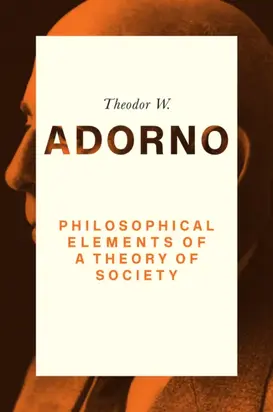
As an exile in America during the War, Theodor Adorno grew acquainted with the fundamentals of empirical social research, something which would shape the work he undertook in the early 1950s as co-director of the Frankfurt Institute for Social Research. Yet he also became increasingly aware of the ‘fetishism of method’ in sociology, and saw the serious limitations of theoretical work based solely on empirical findings. In this lecture course given in 1964, Adorno develops a critique of both sociology and philosophy, emphasizing that theoretical work requires a specific mediation between the two disciplines. Adorno advocates a philosophical approach to social theory that challenges the drive towards uniformity and a lack of ambiguity, highlighting instead the fruitfulness of experience, in all its messy complexity, for critical social analysis. At the same time, he shows how philosophy must also realise that it requires sociology if it is to avoid falling for the old idealistic illusion that the totality of real conditions can be grasped through thought alone. Masterfully bringing together philosophical and empirical approaches to an understanding of society, these lectures from one of the most important social thinkers of the 20th century will be of great interest to students and scholars in philosophy, sociology and the social sciences generally.








Жанр в блоке книги Афоризмы И Цитаты
This classic book by Theodor W. Adorno anticipates many of the themes that have since become common in contemporary philosophy: the critique of foundationalism, the illusions of idealism and the end of epistemology. It also foreshadows many of the key ideas that were developed by Adorno in his most important philosophical works, including Negative Dialectics. Against Epistemology is based on a manuscript Adorno originally wrote in Oxford in 1934-37 during his first years in exile and subsequently reworked in Frankfurt in 1955-56. The text was written as a critique of Husserl’s phenomenology, but the critique of phenomenology is used as the occasion for a much broader critique of epistemology. Adorno described this as a ‘metacritique’ which blends together the analysis of Husserl’s phenomenology as the most advanced instance of the decay of bourgeois idealism with an immanent critique of the tensions and contradictions internal to Husserl’s thought. The result is a powerful text which remains one of the most devastating critiques of Husserl’s work ever written and which heralded many of the ideas that have become commonplace in contemporary philosophy.

6 Количество книг
2 Количество книг
2 Количество книг
