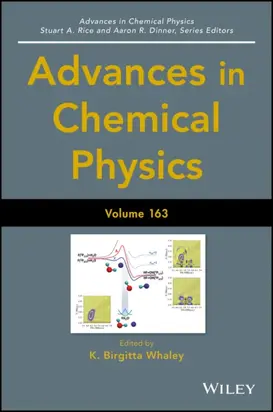
The Advances in Chemical Physics series provides the chemical physics field with a forum for critical, authoritative evaluations of advances in every area of the discipline. • This is the only series of volumes available that presents the cutting edge of research in chemical physics • Includes 10 contributions from leading experts in this field of research • Contains a representative cross-section of research in chemical reaction dynamics and state of the art quantum description of intramolecular and intermolecular dynamics • Structured with an editorial framework that makes the book an excellent supplement to an advanced graduate class in physical chemistry, chemical physics, or molecular physics
Recent advances from internationally recognized researchers Advances in Chemical Physics is the only series of volumes available to represent the cutting edge of research in the discipline. It creates a forum for critical, authoritative evaluations of advances in every area of the chemical physics field. Volume 128 continues to report recent developments with significant, up-to-date chapters by internationally recognized researchers. Volume 128 includes: «Nucleation in Polymer Crystallization,» by M. Muthukumar; «Theory of Constrained Brownian Motion,» by David C. Morse; «Superparamagnetism and Spin-glass Dynamics of Interacting Magnetic Nanoparticle Systems,» by Petra E. Jönnson; «Wavepacket Theory of Photodissociation and Reactive Scattering,» by Gabriel G. Balint-Kurti; and «The Momentum Density Perspective of the Electronic Structure of Atoms and Molecules,» by Ajit J. Thakkar. Students and professionals in chemical physics and physical chemistry, as well as those working in the chemical, pharmaceutical, and polymer industries, will find Advances in Chemical Physics, Volume 128 to be an indispensable survey of the field.
This series provides the chemical physics field with a forum for critical, authoritative evaluations of advances in every area of the discipline. Volume 129 in the series continues to report recent advances with significant, up-to-date chapters by internationally recognized researchers.
This series provides the chemical physics field with a forum for critical, authoritative evaluations of advances in every area of the discipline. Volume 131 includes chapters on: Polyelectrolyte Dynamics; Hydrodynamics and Slip at the Liquid-Solid Interface; Structure of Ionic Liquids and Ionic Liquid Compounds: Are Ionic Liquids Genuine Liquids in the Conventional Sense?; Chemical Reactions at Very High Pressure; Classical Description of Nonadiabatic Quantum Dynamics; and Non-Born Oppenheimer Variational Calculations of Atoms and Molecules with Explicitly Correlated Gaussian Basis Functions.
The Advances in Chemical Physics series provides the chemical physics field with a forum for critical, authoritative evaluations of advances in every area of the discipline. This special volume focuses on atoms and photos near meso- and nanobodies, an important area of nontechnology. Nanoscale particles are those between 1 and 100 nm, and they obey neither the laws of quantum physics nor of classical physics due to an extensive delocalization of the valence electrons, which can vary depending on size. This means that different physical properties can be obtained from the same atoms or molecules existing in a nanoscale particle size due entirely to differing sizes and shapes. Nanostructured materials have unique optical, magnetic, and electronic properties depending on the size and shape of the nanomaterials. A great deal of interest has surfaced in this arena as of late due to the potential technological applications.
This series provides the chemical physics field with a forum for critical, authoritative evaluations of advances in every area of the discipline. This stand-alone special topics volume reports recent advances in electron-transfer research with significant, up-to-date chapters by internationally recognized researchers.
Advances in Chemical Physics is the only series of references available that explores the cutting edge of research in chemical physics. This series provides the chemical physics field with a forum for critical, authoritative evaluations of advances in every area of the discipline.
Fractals, Diffusion, and Relaxation in Disordered Complex Systems is a special guest-edited, two-part volume of Advances in Chemical Physics that continues to report recent advances with significant, up-to-date chapters by internationally recognized researchers.
An up-to-date account of this cutting-edge research in a consistent and understandable framework, of special interest to experts in other areas of electronic structure and/or quantum many-body theory. It will serve equally well as a self-contained guide to learning about reduced density matrices either through self-study or in a classroom as well as an invaluable resource for understanding the critical advancements in the field.
Fractals, Diffusion and Relaxation in Disordered Complex Systems is a special guest-edited, two-part volume of Advances in Chemical Physics that continues to report recent advances with significant, up-to-date chapters by internationally recognized researchers.
The Advances in Chemical Physics series—the cutting edge of research in chemical physics The Advances in Chemical Physics series provides the chemical physics and physical chemistry fields with a forum for critical, authoritative evaluations of advances in every area of the discipline. Filled with cutting-edge research reported in a cohesive manner not found elsewhere in the literature, each volume of the Advances in Chemical Physics series offers contributions from internationally renowned chemists and serves as the perfect supplement to any advanced graduate class devoted to the study of chemical physics. This volume explores: Hydrogen Bond Topology and Proton Ordering in Ice and Water Clusters (Sherwin J. Singer and Chris Knight) Molecular Inner-Shell Spectroscopy, Arpis Technique and Its Applications (Eiji Shigemasa and Nobuhiro Kosugi) Geometric Optimal Control of Simple Quantum Systems: Geometric Optimal Control Theory (Dominique Sugny) Density Matrix Equation for a Bathed Small System and its Application to Molecular Magnets (D. A. Garanin) A Fractional Langevin Equation Approach to Diffusion Magnetic Resonance Imaging (Jennie Cooke)
The Advances in Chemical Physics series—the cutting edge of research in chemical physics The Advances in Chemical Physics series provides the chemical physics field with a forum for critical, authoritative evaluations of advances in every area of the discipline. Filled with cutting-edge research reported in a cohesive manner not found elsewhere in the literature, each volume of the Advances in Chemical Physics series serves as the perfect supplement to any advanced graduate class devoted to the study of chemical physics. This volume explores: Quantum Dynamical Resonances in Chemical Reactions: From A + BC to Polyatomic Systems (Kopin Liu) The Multiscale Coarse-Graining Method (Lanyuan Lu and Gregory A. Voth) Molecular Solvation Dynamics from Inelastic X-ray Scattering Measurements (R.H. Coridan and G.C.L. Wong) Polymers Under Confinement (M. Muthukumar) Computational Studies of the Properties of DNA-linked Nanomaterials (One-Sun Lee and George C. Schatz) Nanopores: Single-Molecule Sensors of Nucleic Acid Based Complexes (Amit Meller)
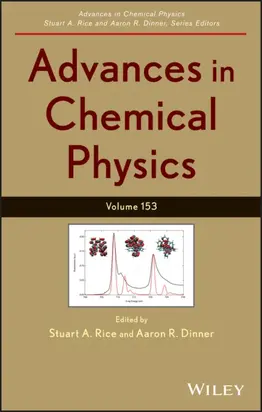
Detailed reviews of new and emerging topics in chemical physics presented by leading experts The Advances in Chemical Physics series is dedicated to reviewing new and emerging topics as well as the latest developments in traditional areas of study in the field of chemical physics. Each volume features detailed comprehensive analyses coupled with individual points of view that integrate the many disciplines of science that are needed for a full understanding of chemical physics. Volume 153 of Advances in Chemical Physics features six expertly written contributions: Recent advances of ultrafast X-ray absorption spectroscopy for molecules in solution Scaling perspective on intramolecular vibrational energy flow: analogies, insights, and challenges Longest relaxation time of relaxation processes for classical and quantum Brownian motion in a potential escape rate theory approach Local fluctuations in solution: theory and applications Macroscopic effects of microscopic heterogeneity Ab initio methodology for pseudospin Hamiltonians of anisotropic magnetic centers Reviews published in Advances in Chemical Physics are typically longer than those published in journals, providing the space needed for readers to fully grasp the topic: the fundamentals as well as the latest discoveries, applications, and emerging avenues of research. Extensive cross-referencing enables readers to explore the primary research studies underlying each topic. Advances in Chemical Physics is ideal for introducing novices to topics in chemical physics. Moreover, the series provides the foundation needed for more experienced researchers to advance their own research studies and continue to expand the boundaries of our knowledge in chemical physics.
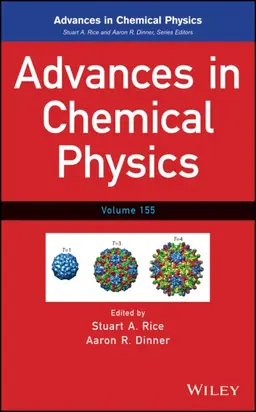
The cutting edge of research in chemical physics Each volume of the Advances in Chemical Physics series discusses aspects of the state of diverse subjects in chemical physics and related fields, with chapters written by top researchers in the field. Reviews published in Advances in Chemical Physics are typically longer than those published in journals, providing the space needed for readers to fully grasp the topic, including fundamentals, latest discoveries, applications, and emerging avenues of research. Volume 155 explores: Modeling viral capsid assembly Charges at aqueous interfaces, including the development of computational approaches in direct contact with the experiment Theory and simulation advances in solute precipitate nucleation A computational viewpoint of water in the liquid state Construction of energy functions for lattice heteropolymer models, including efficient encodings for constraint satisfaction programming and quantum annealing Advances in Chemical Physics is ideal for introducing novices to topics in chemical physics and serves as the perfect supplement to any advanced graduate class devoted to its study. The series also provides the foundation needed for more experienced researchers to advance research studies.
This series provides the chemical physics field with a forum for critical, authoritative evaluations of advances in every area of the discipline. Topics included in this volume include recent developments in classical density functional theory, nonadiabatic chemical dynamics in intermediate and intense laser fields, and bilayers and their simulation.
The Advances in Chemical Physics series presents the cutting edge in every area of the discipline and provides the field with a forum for critical, authoritative evaluations of advances. It provides an editorial framework that makes each volume an excellent supplement to advanced graduate classes, with contributions from experts around the world and a handy glossary for easy reference on new terminology. This series is a wonderful guide for students and professionals in chemical physics and physical chemistry, from academia, government, and industries including chemicals, pharmaceuticals, and polymers.
The Advances in Chemical Physics series presents the cutting edge in every area of the discipline and provides the field with a forum for critical, authoritative evaluations of advances. It provides an editorial framework that makes the book an excellent supplement to advanced graduate classes, with contributions from experts around the world and a handy glossary for easy reference on new terminology. This series is a wonderful guide for students and professionals in chemical physics and physical chemistry, from academia, government, and industries including chemicals, pharmaceuticals, and polymers.