

H. Steven Goldberg Скачать все книги 5 Количество книг



Жанр в блоке книги Техническая Литература
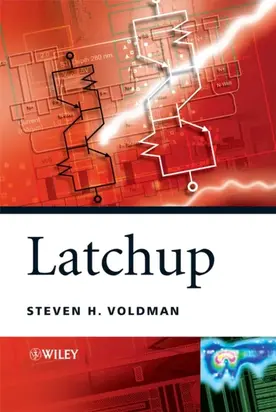
Interest in latchup is being renewed with the evolution of complimentary metal-oxide semiconductor (CMOS) technology, metal-oxide-semiconductor field-effect transistor (MOSFET) scaling, and high-level system-on-chip (SOC) integration. Clear methodologies that grant protection from latchup, with insight into the physics, technology and circuit issues involved, are in increasing demand. This book describes CMOS and BiCMOS semiconductor technology and their sensitivity to present day latchup phenomena, from basic over-voltage and over-current conditions, single event latchup (SEL) and cable discharge events (CDE), to latchup domino phenomena. It contains chapters focusing on bipolar physics, latchup theory, latchup and guard ring characterization structures, characterization testing, product level test systems, product level testing and experimental results. Discussions on state-of-the-art semiconductor processes, design layout, and circuit level and system level latchup solutions are also included, as well as: latchup semiconductor process solutions for both CMOS to BiCMOS, such as shallow trench, deep trench, retrograde wells, connecting implants, sub-collectors, heavily-doped buried layers, and buried grids – from single- to triple-well CMOS; practical latchup design methods, automated and bench-level latchup testing methods and techniques, latchup theory of logarithm resistance space, generalized alpha (a) space, beta (b) space, new latchup design methods– connecting the theoretical to the practical analysis, and; examples of latchup computer aided design (CAD) methodologies, from design rule checking (DRC) and logical-to-physical design, to new latchup CAD methodologies that address latchup for internal and external latchup on a local as well as global design level. Latchup acts as a companion text to the author’s series of books on ESD (electrostatic discharge) protection, serving as an invaluable reference for the professional semiconductor chip and system-level ESD engineer. Semiconductor device, process and circuit designers, and quality, reliability and failure analysis engineers will find it informative on the issues that confront modern CMOS technology. Practitioners in the automotive and aerospace industries will also find it useful. In addition, its academic treatment will appeal to both senior and graduate students with interests in semiconductor process, device physics, computer aided design and design integration.
Жанр в блоке книги Техническая Литература
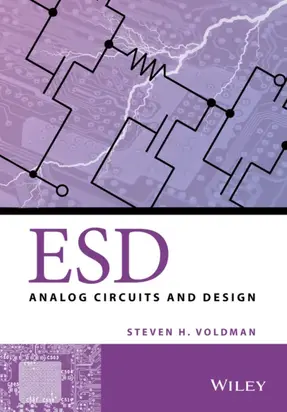
A comprehensive and in-depth review of analog circuit layout, schematic architecture, device, power network and ESD design This book will provide a balanced overview of analog circuit design layout, analog circuit schematic development, architecture of chips, and ESD design. It will start at an introductory level and will bring the reader right up to the state-of-the-art. Two critical design aspects for analog and power integrated circuits are combined. The first design aspect covers analog circuit design techniques to achieve the desired circuit performance. The second and main aspect presents the additional challenges associated with the design of adequate and effective ESD protection elements and schemes. A comprehensive list of practical application examples is used to demonstrate the successful combination of both techniques and any potential design trade-offs. Chapter One looks at analog design discipline, including layout and analog matching and analog layout design practices. Chapter Two discusses analog design with circuits, examining: single transistor amplifiers; multi-transistor amplifiers; active loads and more. The third chapter covers analog design layout (also MOSFET layout), before Chapters Four and Five discuss analog design synthesis. The next chapters introduce the reader to analog-digital mixed signal design synthesis, analog signal pin ESD networks, and analog ESD power clamps. Chapter Nine, the last chapter, covers ESD design in analog applications. Clearly describes analog design fundamentals (circuit fundamentals) as well as outlining the various ESD implications Covers a large breadth of subjects and technologies, such as CMOS, LDMOS, BCD, SOI, and thick body SOI Establishes an “ESD analog design” discipline that distinguishes itself from the alternative ESD digital design focus Focuses on circuit and circuit design applications Assessible, with the artwork and tutorial style of the ESD book series PowerPoint slides are available for university faculty members Even in the world of digital circuits, analog and power circuits are two very important but under-addressed topics, especially from the ESD aspect. Dr. Voldman’s new book will serve as an essential and practical guide to the greater IC community. With high practical and academic values this book is a “bible” for professionals, graduate students, device and circuit designers for investigating the physics of ESD and for product designs and testing.
Жанр в блоке книги Техническая Литература
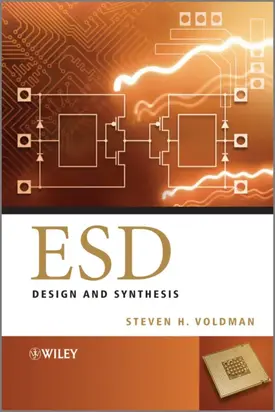
Electrostatic discharge (ESD) continues to impact semiconductor components and systems as technologies scale from micro- to nano-electronics. This book studies electrical overstress, ESD, and latchup from a whole-chip ESD design synthesis approach. It provides a clear insight into the integration of ESD protection networks from a generalist perspective, followed by examples in specific technologies, circuits, and chips. Uniquely both the semiconductor chip integration issues and floorplanning of ESD networks are covered from a ‘top-down' design approach. Look inside for extensive coverage on: integration of cores, power bussing, and signal pins in DRAM, SRAM, CMOS image processing chips, microprocessors, analog products, RF components and how the integration influences ESD design and integration architecturing of mixed voltage, mixed signal, to RF design for ESD analysis floorplanning for peripheral and core I/O designs, and the implications on ESD and latchup guard ring integration for both a ‘bottom-up' and ‘top-down' methodology addressing I/O guard rings, ESD guard rings, I/O to I/O, and I/O to core classification of ESD power clamps and ESD signal pin circuitry, and how to make the correct choice for a given semiconductor chip examples of ESD design for the state-of-the-art technologies discussed, including CMOS, BiCMOS, silicon on insulator (SOI), bipolar technology, high voltage CMOS (HVCMOS), RF CMOS, and smart power practical methods for the understanding of ESD circuit power distribution, ground rule development, internal bus distribution, current path analysis, quality metrics ESD: Design and Synthesis is a continuation of the author's series of books on ESD protection. It is an essential reference for: ESD, circuit, and semiconductor engineers; design synthesis team leaders; layout design, characterisation, floorplanning, test and reliability engineers; technicians; and groundrule and test site developers in the manufacturing and design of semiconductor chips. It is also useful for graduate and undergraduate students in electrical engineering, semiconductor sciences, and manufacturing sciences, and on courses involving the design of ESD devices, chips and systems. This book offers a useful insight into the issues that confront modern technology as we enter the nano-electronic era.

Жанр в блоке книги Техническая Литература
With the evolution of semiconductor technology and global diversification of the semiconductor business, testing of semiconductor devices to systems for electrostatic discharge (ESD) and electrical overstress (EOS) has increased in importance. ESD Testing: From Components to Systems updates the reader in the new tests, test models, and techniques in the characterization of semiconductor components for ESD, EOS, and latchup. Key features: Provides understanding and knowledge of ESD models and specifications including human body model (HBM), machine model (MM), charged device model (CDM), charged board model (CBM), cable discharge events (CDE), human metal model (HMM), IEC 61000-4-2 and IEC 61000-4-5. Discusses new testing methodologies such as transmission line pulse (TLP), to very fast transmission line pulse (VF-TLP), and future methods of long pulse TLP, to ultra-fast TLP (UF-TLP). Describes both conventional testing and new testing techniques for both chip and system level evaluation. Addresses EOS testing, electromagnetic compatibility (EMC) scanning, to current reconstruction methods. Discusses latchup characterization and testing methodologies for evaluation of semiconductor technology to product testing. ESD Testing: From Components to Systems is part of the authors’ series of books on electrostatic discharge (ESD) protection; this book will be an invaluable reference for the professional semiconductor chip and system-level ESD and EOS test engineer. Semiconductor device and process development, circuit designers, quality, reliability and failure analysis engineers will also find it an essential reference. In addition, its academic treatment will appeal to both senior and graduate students with interests in semiconductor process, device physics, semiconductor testing and experimental work.

Жанр в блоке книги Зарубежная Деловая Литература
Praise for BILLIONS OF DROPS in MILLIONS OF BUCKETS «Billions of Drops in Millions of Buckets provides a bracing and original look at philan-thropy that offers a much-needed corrective to conventional wisdom. Steve Goldberg combines a resolve to understand why so much philanthropy accomplishes so little enduring social change with a timely and serious proposal to reinvigorate nonprofit capital markets through the simplest of insights: getting more of the money to where it can do the most good. This book will change how forward-looking philanthropists, foundations, and policymakers think about the relationship between charitable giving and the transformative capacity of social entrepreneurs.» —Jerr Boschee, founder and Executive Director, The Institute for Social Entrepreneurs; Visiting Professor of the Practice in Social Enterprise, Carnegie Mellon University «Goldberg's arguments are logical next steps in the rapidly evolving discussion of social capital markets. He offers ambitious proposals informed by the reality of current practices and focused on an achievable set of goals. He fully recognizes the potential for restructuring that is inherent in this time of financial hardship. Real change relies on big ideas, and Steve Goldberg offers us several.» —Lucy Bernholz, author of Creating Philanthropic Capital Markets: The Deliberate Evolution «When I first heard about 'evidence-based medicine,' I thought: 'you mean it isn't?' Read this book and that's how you'll feel about 'performance-based philanthropy.' Goldberg takes some of the best current management thinking and applies it to social enterprise, illuminating both the encouraging successes of social entrepreneurs and the barriers they face. Even better, he presents compelling ideas for making the social sector vastly more effective.» —Christopher Meyer, Chief Executive, Monitor Networks «Goldberg calls for more 'performance-driven philanthropy,' where nonprofits are rewarded based on their results, in place of the current dysfunction. It is an important call and a valuable contribution to discussions about how to improve nonprofits in the U.S. and internationally.» —Martin Brookes, Chief Executive, New Philanthropy Capital «Billions of Drops… is a must-read romp through emerging fields of social entrepre-neurship and nonprofit capital markets.» —George Overholser, founder and Managing Director, NFF Capital Partners

6 Количество книг
2 Количество книг
2 Количество книг
