

L. Richard Peterson Скачать все книги 6 Количество книг


Жанр в блоке книги Зарубежная Деловая Литература
Lessons for leaders on resolving the ongoing struggle between instinct and the creative mind Kings, heads of government, and corporate executives lead thousands of people and manage endless resources, but may not have mastery over themselves. Often leaders know that right action is important, but have little (if any) understanding of what prevents them from acting in accordance with their intentions. In this important book, leadership expert Richard Daft portrays this dilemma as a struggle between instinct (elephant) and intention (the executive) using the most current research on the intentional vs. the habitual mind to explain how this phenomenon occurs. Based on current research and real-life examples Offers leaders a method for directing themselves more productively Written by an expert in leadership, organizational performance, and change management Through real-life examples and recent studies in psychology, management and Eastern spirituality Daft provides guidance to all of us who struggle finding our own balance and cultivating the behavior of others.
Жанр в блоке книги Зарубежная Деловая Литература
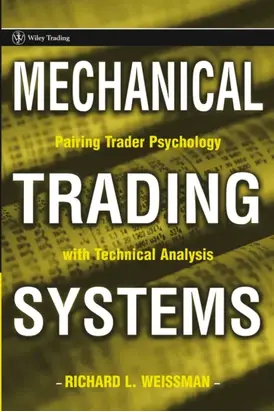
A wide variety of flexible trading systems that combine sophisticated technical analysis with trading psychology theory Mechanical Trading Systems examines the development process for choosing and using mechanical trading systems in conjunction with trader psychology. This book discusses the advantages and disadvantages of mechanical trading systems; the dangers in system development and how to avoid them; the optimal methods for back-testing trading systems; position sizing and other risk quantification tools; and methods of improving rates of return on investments without significantly increasing risk. Most importantly, through a detailed examination of various types of unsuccessful trader personality traits (e.g., fearfulness, greed, and impatience), the book recommends different types of trading systems for a diverse array of trader types. Richard L. Weissman (Port Richey, FL) has seventeen years' experience as a trader and developer of trading systems. He currently provides independent consultation an d training services to traders and risk management professionals in the areas of technical analysis, risk management, and trader psychology.
Жанр в блоке книги Зарубежная Деловая Литература
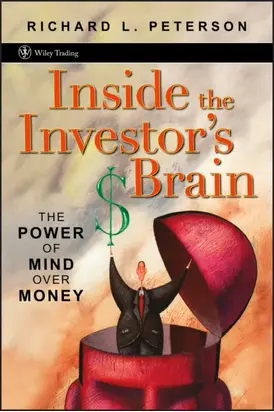
Unique insights into how the mind of an investor operates and how developing emotional awareness leads to long-term success Inside the Investor's Brain provides readers with specific techniques for understanding their financial psychology, so that they can improve their own performance and learn how to outsmart other investors. Chapter by chapter, author Richard Peterson addresses various mental traps and how they play a role in investing. Through examples, such as a gambling experiment with playing cards, the author shows readers how being aware of the subconscious can separate the smart investors from the average ones. This book also contains descriptions of the work of neuroscientists, financial practitioners, and psychologists, offering an expert's view into the mind of the market. Innovative and accessible, Inside the Investor's Brain gives investors the tools they need to better understand how emotions and mental biases affect the way they manage money and react to market moves.

Жанр в блоке книги Зарубежная Деловая Литература
An investor's guide to understanding the most elusive (yet most important) aspect of successful investing – yourself. Why is it that the investing performance of so many smart people reliably and predictably falls short? The answer is not that they know too little about the markets. In fact, they know too little about themselves. Combining the latest findings from the academic fields of behavioral finance and experimental psychology with the down-and-dirty real-world wisdom of successful investors, Drs. Richard Peterson and Frank Murtha guide both new and experienced investors through the psychological learning process necessary to achieve their financial goals. In an easy and entertaining style that masks the book’s scientific rigor, the authors make complex scientific insights readily understandable and actionable, shattering a number of investing myths along the way. You will gain understanding of your true investing motivations, learn to avoid the unseen forces that subvert your performance, and build your investor identity – the foundation for long-lasting investing success. Replete with humorous games, insightful self-assessments, entertaining exercises, and concrete planning tools, this book goes beyond mere education. MarketPsych: How to Manage Fear and Build Your Investor Identity functions as a psychological outfitter for your unique investing journey, providing the tools, training and equipment to help you navigate the right paths, stay on them, and see your journey through to success.
Жанр в блоке книги Зарубежная Деловая Литература
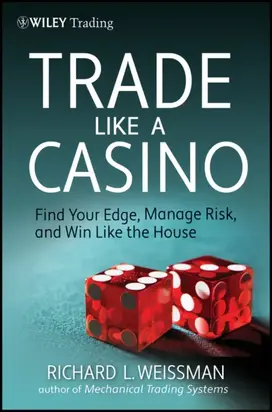
A detailed look at the common characteristics found in most successful traders While there are a variety of approaches to trading in the financial markets, profitable traders tend to share similar underlying characteristics. Most have a methodology that they believe will prove profitable over the long run and are willing to endure short-term setbacks. If you're looking to make the most of your time in today's markets, you need to understand what separates the best from the rest. And with Trade Like a Casino, you'll gain the knowledge needed to excel at this challenging endeavor. Engaging and informative, this reliable guide identifies and explains the key techniques and mental processes characteristic of successful traders. It reveals that successful traders operate very much like a casino in that they develop a method that gives them «positive expectancy» and they unflappably implement the method in the face of changing, and oftentimes volatile, market conditions. Page by page, the book explores the intricacies of methodology, mental control, and flexibility that allow traders to develop and maintain the casino-like edge. Reveals how many successful traders tend to follow the same general principles, even if their approach to trading may differ Explores how to account for the risk of being wrong and the market moving against you Discusses how to develop an approach that combines trade selection with sound risk management, avoids emotional attachment to positions, exploits volatility cycles, and focuses on market action Regardless of how you approach markets, the insights found here will help improve the way you trade by putting you in a better position to distinguish the differences between successful and unsuccessful traders.
Жанр в блоке книги Зарубежная Деловая Литература
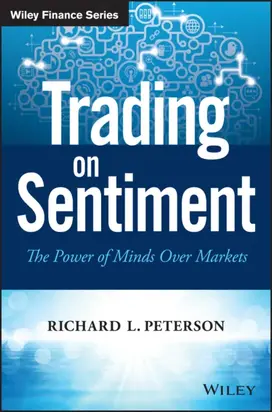
In his debut book on trading psychology, Inside the Investor’s Brain, Richard Peterson demonstrated how managing emotions helps top investors outperform. Now, in Trading on Sentiment, he takes you inside the science of crowd psychology and demonstrates that not only do price patterns exist, but the most predictable ones are rooted in our shared human nature. Peterson’s team developed text analysis engines to mine data – topics, beliefs, and emotions – from social media. Based on that data, they put together a market-neutral social media-based hedge fund that beat the S&P 500 by more than twenty-four percent—through the 2008 financial crisis. In this groundbreaking guide, he shows you how they did it and why it worked. Applying algorithms to social media data opened up an unprecedented world of insight into the elusive patterns of investor sentiment driving repeating market moves. Inside, you gain a privileged look at the media content that moves investors, along with time-tested techniques to make the smart moves—even when it doesn’t feel right. This book digs underneath technicals and fundamentals to explain the primary mover of market prices – the global information flow and how investors react to it. It provides the expert guidance you need to develop a competitive edge, manage risk, and overcome our sometimes-flawed human nature. Learn how traders are using sentiment analysis and statistical tools to extract value from media data in order to: Foresee important price moves using an understanding of how investors process news. Make more profitable investment decisions by identifying when prices are trending, when trends are turning, and when sharp market moves are likely to reverse. Use media sentiment to improve value and momentum investing returns. Avoid the pitfalls of unique price patterns found in commodities, currencies, and during speculative bubbles Trading on Sentiment deepens your understanding of markets and supplies you with the tools and techniques to beat global markets— whether they’re going up, down, or sideways.

6 Количество книг
2 Количество книг
2 Количество книг
