

Panik Michael J. Скачать все книги 4 Количество книг



Жанр в блоке книги Математика
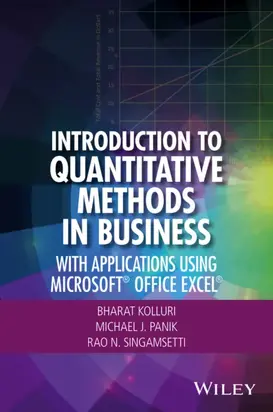
A well-balanced and accessible introduction to the elementary quantitative methods and Microsoft® Office Excel® applications used to guide business decision making Featuring quantitative techniques essential for modeling modern business situations, Introduction to Quantitative Methods in Business: With Applications Using Microsoft® Office Excel® provides guidance to assessing real-world data sets using Excel. The book presents a balanced approach to the mathematical tools and techniques with applications used in the areas of business, finance, economics, marketing, and operations. The authors begin by establishing a solid foundation of basic mathematics and statistics before moving on to more advanced concepts. The first part of the book starts by developing basic quantitative techniques such as arithmetic operations, functions and graphs, and elementary differentiations (rates of change), and integration. After a review of these techniques, the second part details both linear and nonlinear models of business activity. Extensively classroom-tested, Introduction to Quantitative Methods in Business: With Applications Using Microsoft® Office Excel® also includes: Numerous examples and practice problems that emphasize real-world business quantitative techniques and applications Excel-based computer software routines that explore calculations for an assortment of tasks, including graphing, formula usage, solving equations, and data analysis End-of-chapter sections detailing the Excel applications and techniques used to address data and solutions using large data sets A companion website that includes chapter summaries, Excel data sets, sample exams and quizzes, lecture slides, and an Instructors’ Solutions Manual Introduction to Quantitative Methods in Business: With Applications Using Microsoft® Office Excel® is an excellent textbook for undergraduate-level courses on quantitative methods in business, economics, finance, marketing, operations, and statistics. The book is also an ideal reference for readers with little or no quantitative background who require a better understanding of basic mathematical and statistical concepts used in economics and business. Bharat Kolluri, Ph.D., is Professor of Economics in the Department of Economics, Finance, and Insurance at the University of Hartford. A member of the American Economics Association, his research interests include econometrics, business statistics, quantitative decision making, applied macroeconomics, applied microeconomics, and corporate finance. Michael J. Panik, Ph.D., is Professor Emeritus in the Department of Economics, Finance, and Insurance at the University of Hartford. He has served as a consultant to the Connecticut Department of Motor Vehicles as well as to a variety of health care organizations. In addition, Dr. Panik is the author of numerous books, including Growth Curve Modeling: Theory and Applications and Statistical Inference: A Short Course, both published by Wiley. Rao N. Singamsetti, Ph.D., is Associate Professor in the Department of Economics, Finance, and Insurance at the University of Hartford. A member of the American Economics Association, his research interests include the status of war on poverty in the United States since the 1960s and forecasting foreign exchange rates using econometric methods.
Жанр в блоке книги Математика
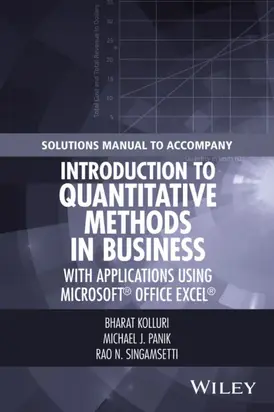
Solutions Manual to accompany Introduction to Quantitative Methods in Business: With Applications Using Microsoft® Office Excel®
Жанр в блоке книги Математика
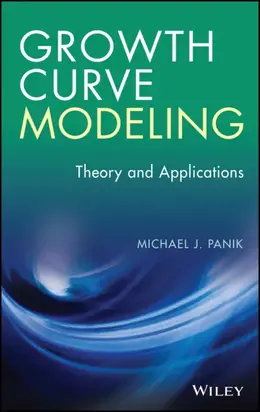
Features recent trends and advances in the theory and techniques used to accurately measure and model growth Growth Curve Modeling: Theory and Applications features an accessible introduction to growth curve modeling and addresses how to monitor the change in variables over time since there is no “one size fits all” approach to growth measurement. A review of the requisite mathematics for growth modeling and the statistical techniques needed for estimating growth models are provided, and an overview of popular growth curves, such as linear, logarithmic, reciprocal, logistic, Gompertz, Weibull, negative exponential, and log-logistic, among others, is included. In addition, the book discusses key application areas including economic, plant, population, forest, and firm growth and is suitable as a resource for assessing recent growth modeling trends in the medical field. SAS® is utilized throughout to analyze and model growth curves, aiding readers in estimating specialized growth rates and curves. Including derivations of virtually all of the major growth curves and models, Growth Curve Modeling: Theory and Applications also features: • Statistical distribution analysis as it pertains to growth modeling • Trend estimations • Dynamic site equations obtained from growth models • Nonlinear regression • Yield-density curves • Nonlinear mixed effects models for repeated measurements data Growth Curve Modeling: Theory and Applications is an excellent resource for statisticians, public health analysts, biologists, botanists, economists, and demographers who require a modern review of statistical methods for modeling growth curves and analyzing longitudinal data. The book is also useful for upper-undergraduate and graduate courses on growth modeling.
Жанр в блоке книги Математика
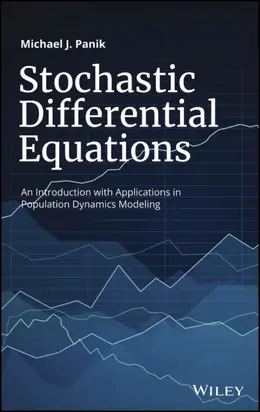
A beginner’s guide to stochastic growth modeling The chief advantage of stochastic growth models over deterministic models is that they combine both deterministic and stochastic elements of dynamic behaviors, such as weather, natural disasters, market fluctuations, and epidemics. This makes stochastic modeling a powerful tool in the hands of practitioners in fields for which population growth is a critical determinant of outcomes. However, the background requirements for studying SDEs can be daunting for those who lack the rigorous course of study received by math majors. Designed to be accessible to readers who have had only a few courses in calculus and statistics, this book offers a comprehensive review of the mathematical essentials needed to understand and apply stochastic growth models. In addition, the book describes deterministic and stochastic applications of population growth models including logistic, generalized logistic, Gompertz, negative exponential, and linear. Ideal for students and professionals in an array of fields including economics, population studies, environmental sciences, epidemiology, engineering, finance, and the biological sciences, Stochastic Differential Equations: An Introduction with Applications in Population Dynamics Modeling: • Provides precise definitions of many important terms and concepts and provides many solved example problems • Highlights the interpretation of results and does not rely on a theorem-proof approach • Features comprehensive chapters addressing any background deficiencies readers may have and offers a comprehensive review for those who need a mathematics refresher • Emphasizes solution techniques for SDEs and their practical application to the development of stochastic population models An indispensable resource for students and practitioners with limited exposure to mathematics and statistics, Stochastic Differential Equations: An Introduction with Applications in Population Dynamics Modeling is an excellent fit for advanced undergraduates and beginning graduate students, as well as practitioners who need a gentle introduction to SDEs. Michael J. Panik, PhD, is Professor in the Department of Economics, Barney School of Business and Public Administration at the University of Hartford in Connecticut. He received his PhD in Economics from Boston College and is a member of the American Mathematical Society, The American Statistical Association, and The Econometric Society.

6 Количество книг
2 Количество книг
2 Количество книг
