

L. Kenneth Fisher Скачать все книги 11 Количество книг



Жанр в блоке книги Техническая Литература
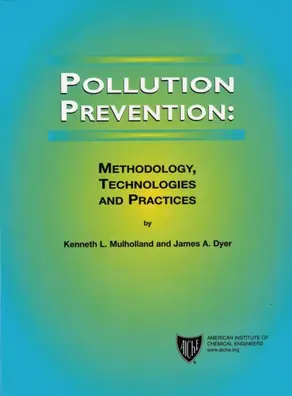
As many industries are beginning to learn, pollution prevention technologies offer more than just a way to comply with regulations, or even to “do the right thing.” It also makes smart business sense. The authors of this book, both veterans of DuPont’s in-house waste reduction team, have put together a “how-to” guide for locating and implementing the best pollution prevention strategies for particular manufacturing processes. The book codifies elements of fundamental pollution prevention knowledge that are “easily understood and broadly applicable,” across a wide range of industries. At the heart of the book is what the authors call the “10-Step Method for Engineering Evaluations of Pollution Prevention Methods,” which breaks down the process to such simple steps as defining problems, setting goals, and identifying, defining, and evaluating alternative strategies.

Жанр в блоке книги Техническая Литература
Regardless of its size or nature, every industry generates waste and is responsible for imple-menting the practices of pollution prevention and waste minimization in its day-to-day operations. Whether it's dirty water or toxic wastes, industrial pollution is all the same in one way: it reduces a business's profitability. Identification of Cleaner Production Improvement Opportunities urges environmental, health, and safety department managers, industrial environmental consultants, and personnel across all chemical engineering industries to employ a forward-thinking and tested technology of process improvements that will reduce waste generation, reduce the resources requirements to manufacture a product, and, most important to the life of a business, increase revenues. This new publication consists of the following five sections: * Section I: The relationships among cleaner production, waste, cleaner production analyses, and their business values * Section II: How to develop a cleaner production program * Section III: The data requirements and data analyses for the opportunity identification step * Section IV: The opportunity identification step * Section V: How to assess and rank the best ideas Industry expert and chair of AIChE's Environmental Division, Kenneth Mulholland introduces methodology in this manual that has been used to identify process improvement opportunities for more than fifty processes, including pharmaceutical intermediates, elastomer monomers and polymers, polyester intermediates and polymers, batch processes such as agricultural products and paints, chlorofluoro-hydrocarbon and chlorocarbon processes, and specialty chemicals and waste water treatment facilities. With no product changes or new technology necessary, these process improvements have produced a 200 percent internal rate of return and reduced waste generation by 40 percent to 50 percent.
Жанр в блоке книги Зарубежная Деловая Литература
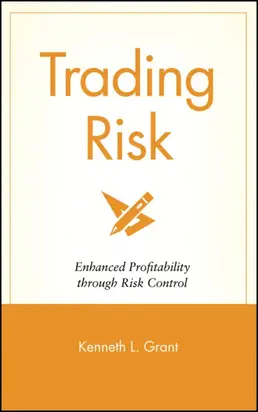
Revolutionary techniques that traders can implement to improve profits and avoid losses No trader, professional or individual, can afford not to have a solid risk management program integrated into his or her trading system. But finding a precise mathematical model to replace subjective decision-making processes is a challenge. Traditionally, risk management has focused solely on loss avoidance, but in Trading Risk, hedge fund risk manager Kenneth Grant presents some-thing completely new—how to manage a portfolio to minimize risk and increase profits by putting more capital at risk. Trading Risk details a risk management program that can help both money managers and individual traders evaluate which elements in a portfolio are working efficiently and which aren’t. By illustrating an extremely simple set of statistical and arithmetic tools this book can help readers enhance their performance in many financial markets. Kenneth L.Grant is Cheyne’s Global Risk Manager, and is the Managing Member for Cheyne Capital, LLC, the firm’s U.S. arm. Mr. Grant is a pioneer in the field of hedge fund risk management and capital allocation. Before joining Cheyne, he created risk control programs at two of the world’s leading hedge funds, Tudor Investments and SAC Capital, where he was eventually promoted to the title of Chief Investment Strategist. Mr. Grant holds a Bachelor of Science in Economics and Mathematics from the University of Wisconsin, an MA in Economics from Columbia University, and an MBA from the University of Chicago Graduate School of Business.

Жанр в блоке книги Зарубежная Деловая Литература
A timely guide to uncovering financial fraud 2008 and 2009 will be remembered for bear markets, a global credit crunch, and some of the largest investment scams ever. But these scams are nothing new, they've been repeated throughout history, and there will certainly be more to come. But the good news is fraudsters often follow the same basic playbook. Learn the playbook, and know how to ask the right questions, and financial fraud can be easy to detect and simple to avoid. In How to Smell a Rat, trusted financial expert Ken Fisher provides you with an inside's view on how to spot financial disasters before you become a part of them. Filled with in-depth insights and practical advice, this reliable resource takes an engaging look at recent and historic examples of fraudsters, how they operated, and how they can be easily avoided. Fisher also shows you the quick, identifiable features of financial frauds and arms you with the questions to ask when assessing a money manager. Prepares you to identify and avoid financials cams that could instantly destroy your wealth Contains examples that highlight how financial frauds are committed Provides questions everyone should ask before entering any investment endeavor With How to Smell a Rat as your guide, you'll learn how to protect your interests and assets from unnecessary losses.
Жанр в блоке книги Зарубежная Деловая Литература
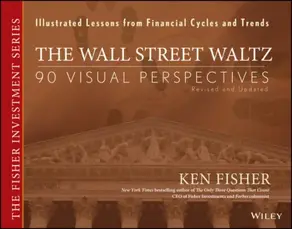
The Wall Street Waltz Introducing the new Fisher Investment SeriesComprised of engaging and informative titles written by renowned money manager and bestselling author Ken Fisher, this series offers essential insights into the worlds of investing and finance. «Any investor who fails to read and heed Ken Fisher's book will have only himself (or herself) to blame if he loses his shirt in the market. Using simple words and dramatic charts, Fisher packs a whole financial education into one neat package.» James W. Michaels, Editor Emeritus and Group Vice President-Editorial, Forbes, Inc. «Ken's book vividly presents a complete picture of the stock market's history-a vital tool for the savvy investor.» Charles R. Schwab, founder, Chairman, and CEO, The Charles Schwab Corporation «If a picture is worth a thousand words, then these charts could be worth your life savings.» William E. Donoghue, Chairman, W. E. Donoghue Co., Inc. «Ken Fisher's clear, insightful analysis makes this a compelling book. For information and entertainment, this is a book to turn to again, and again, and again.» David Dreman, founder, Chairman, and CIO, Dreman Value Management, LLC
Жанр в блоке книги Зарубежная Деловая Литература
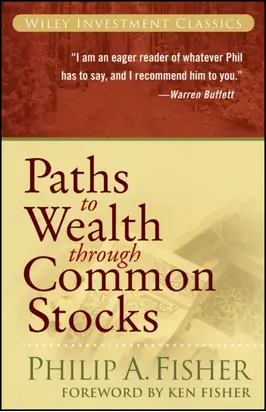
Paths to Wealth through Common Stocks contains one original concept after another, each designed to greatly improve the results of those who self-manage their investments – while helping those who rely on professional investment advice select the right advisor for their needs. Originally written by investment legend Philip A. Fisher in 1960, this timeless classic is now reintroduced by his well-known and respected son, successful money manager Ken Fisher, in a new Foreword. Filled with in-depth insights and expert advice, Paths to Wealth through Common Stocks expands upon the innovative ideas found in Fisher's highly regarded Common Stocks and Uncommon Profits – summarizing how worthwhile profits have been and will continue to be made through common stock ownership, and revealing why his method can increase profits while reducing risk. Many of the ideas found here may depart from conventional investment wisdom, but the impressive results produced by these concepts – which are still relevant in today's market environment – will quickly remind you why Philip Fisher is considered one of the greatest investment minds of our time.
Жанр в блоке книги Зарубежная Деловая Литература
Introducing the new Fisher Investment Series, comprised of engaging and informative titles written by renowned money manager and bestselling author Ken Fisher. This series offers essential insights into the worlds of investing and finance. Over the course of nearly two centuries, the innovations, mistakes, and scandals of different market participants have played an important role in shaping today's financial markets. Now, in 100 Minds That Made the Market, Ken Fisher delivers cameo biographies of these pioneers of American financial history. From Joe Kennedy's «sexcapades» to Jesse Livermore's suicide, this book details the drama, the dirt, and the financial principles of an amazingly inventive group of financial minds. Fisher digs deep to uncover the careers, personal lives, and contributions of these individuals, and leads you through the lessons that can be learned from each one. Here you have 100 of the best teachers – some you already know, some you will feel you know, and some you may not have previously discovered – whose experiences will undoubtedly enhance your understanding of the markets. With a few pages dedicated to each person, 100 Minds That Made the Market quickly captures the essence of the people and ideas that have influenced the evolution of the financial industry.
Жанр в блоке книги Зарубежная Деловая Литература
Widely respected and admired, Philip Fisher is among the most influential investors of all time. His investment philosophies, introduced almost forty years ago, are not only studied and applied by today's financiers and investors, but are also regarded by many as gospel. This book is invaluable reading and has been since it was first published in 1958. The updated paperback retains the investment wisdom of the original edition and includes the perspectives of the author's son Ken Fisher, an investment guru in his own right in an expanded preface and introduction «I sought out Phil Fisher after reading his Common Stocks and Uncommon Profits…A thorough understanding of the business, obtained by using Phil's techniques…enables one to make intelligent investment commitments.» —Warren Buffet
Жанр в блоке книги Личные Финансы
Whether you’re in retirement, just getting ready to retire, or 5, 10, or 40 years out, this book can help you invest smarter your whole life and yes, plan better for retirement. Harmful mythology abounds about retirement investing. Many retirees or soon-to-be retirees have heard a plethora of advice. Take 100 (or 120) and subtract your age to get your equity allocation, put the rest in bonds or cash. Buy only bonds. Buy only high dividend stocks. Or some combination! Buy equity-indexed annuities or some “guaranteed” income product. All examples of a potentially harmful myth many folks believe to be smart, strategic moves. Investors believe preparing for retirement requires a radically different set of tools or a dizzying array of products. Navigating the world of retirement products and services can be a full-time job. But investing for retirement is, in practice, not much (if at all) different from investing. In Your Retirement Plan, Ken Fisher will give readers a workable strategy to either develop their own retirement investing plan or work more successfully with a professional to increase the likelihood of achieving long-term goals while avoiding common pitfalls. The book will include easy-to-follow steps like How to think, correctly, about investing time horizon. How to better figure how much income you need How to determine if a portfolio can provide that income How to figure how much to save each year to achieve retirement goals What pitfalls to avoid And more. . . . In this retirement planning book that's not just for retirees, Fisher will hand readers the tools and confidence they need to better plan for the future.
Жанр в блоке книги Зарубежная Деловая Литература
Legendary money manager Ken Fisher outlines the most common—and costly—mistakes investors make. Small cap stocks are best for all time. Bunk! A trade deficit is bad for markets. Bunk! Stocks can't rise on high unemployment. Bunk! Many investors think they are safest following widely accepted Wall Street wisdom—but much of Wall Street wisdom isn't so wise. In fact, it can be costly bunk. In Debunkery: Learn It, Do It, and Profit From It—Seeing Through Wall Street's Money-Killing Myths, Ken Fisher—named one of the 30 most influential individuals of the last three decades by Investment Advisor magazine—details why so many investors fail to get the long-term results they desire. The short answer is many investors fail to question if what they believe is true—and are therefore blinded by tradition, biases, ideology, or any number of cognitive errors. Your goal as an investor shouldn't be to be error-free—that's impossible. Rather, to be more successful, you should aim to lower your error rate. Debunkery gets you started by debunking 50 common myths—but that's just the beginning. It also gives you the tools you need to continue to do your own debunkery for the rest of your investing career.
Жанр в блоке книги Зарубежная Деловая Литература
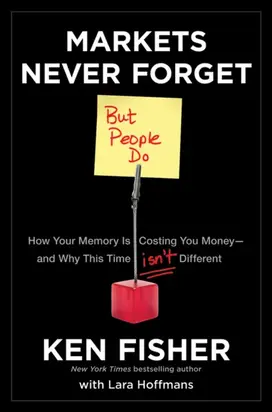
Sir John Templeton, legendary investor, was famous for saying, «The four most dangerous words in investing are, 'This time it's different.'» He knew that though history doesn't repeat, not exactly, history is an excellent guide for investors. In Markets Never Forget But People Do: How Your Memory Is Costing You Money and Why This Time Isn't Different, long-time Forbes columnist, CEO of Fisher Investments, and 4-time New York Times bestselling author Ken Fisher shows how and why investors' memories fail them—and how costly that can be. More important, he shows steps investors can take to begin reducing errors they repeatedly make. The past is never indicative of the future, but history can be one powerful guide in shaping forward looking expectations. Readers can learn how to see the world more clearly—and learn to make fewer errors—by understanding just a bit of investing past.

6 Количество книг
2 Количество книг
2 Количество книг
