

Davies John Скачать все книги 4 Количество книг



Жанр в блоке книги Техническая Литература
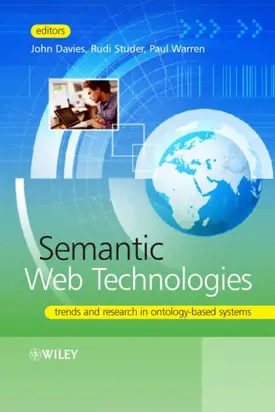
The Semantic Web combines the descriptive languages RDF (Resource Description Framework) and OWL (Web Ontology Language), with the data-centric, customizable XML (eXtensible Mark-up Language) to provide descriptions of the content of Web documents. These machine-interpretable descriptions allow more intelligent software systems to be written, automating the analysis and exploitation of web-based information. Software agents will be able to create automatically new services from already published services, with potentially huge implications for models of e-Business. Semantic Web Technologies provides a comprehensive overview of key semantic knowledge technologies and research. The authors explain (semi-)automatic ontology generation and metadata extraction in depth, along with ontology management and mediation. Further chapters examine how Semantic Web technology is being applied in knowledge management (“Semantic Information Access”) and in the next generation of Web services. Semantic Web Technologies: Provides a comprehensive exposition of the state-of-the art in Semantic Web research and key technologies. Explains the use of ontologies and metadata to achieve machine-interpretability. Describes methods for ontology learning and metadata generation. Discusses ontology management and evolution, covering ontology change detection and propagation, ontology dependency and mediation. Illustrates the theoretical concepts with three case studies on industrial applications in digital libraries, the legal sector and the telecommunication industry. Graduate and advanced undergraduate students, academic and industrial researchers in the field will all find Semantic Web Technologies an essential guide to the technologies of the Semantic Web.
Жанр в блоке книги Техническая Литература
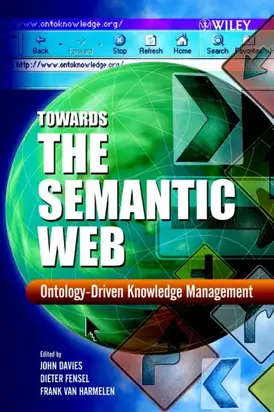
With the current changes driven by the expansion of the World Wide Web, this book uses a different approach from other books on the market: it applies ontologies to electronically available information to improve the quality of knowledge management in large and distributed organizations. Ontologies are formal theories supporting knowledge sharing and reuse. They can be used to explicitly represent semantics of semi-structured information. These enable sophisticated automatic support for acquiring, maintaining and accessing information. Methodology and tools are developed for intelligent access to large volumes of semi-structured and textual information sources in intra- and extra-, and internet-based environments to employ the full power of ontologies in supporting knowledge management from the information client perspective and the information provider. The aim of the book is to support efficient and effective knowledge management and focuses on weakly-structured online information sources. It is aimed primarily at researchers in the area of knowledge management and information retrieval and will also be a useful reference for students in computer science at the postgraduate level and for business managers who are aiming to increase the corporations' information infrastructure. The Semantic Web is a very important initiative affecting the future of the WWW that is currently generating huge interest. The book covers several highly significant contributions to the semantic web research effort, including a new language for defining ontologies, several novel software tools and a coherent methodology for the application of the tools for business advantage. It also provides 3 case studies which give examples of the real benefits to be derived from the adoption of semantic-web based ontologies in «real world» situations. As such, the book is an excellent mixture of theory, tools and applications in an important area of WWW research. * Provides guidelines for introducing knowledge management concepts and tools into enterprises, to help knowledge providers present their knowledge efficiently and effectively. * Introduces an intelligent search tool that supports users in accessing information and a tool environment for maintenance, conversion and acquisition of information sources. * Discusses three large case studies which will help to develop the technology according to the actual needs of large and or virtual organisations and will provide a testbed for evaluating tools and methods. The book is aimed at people with at least a good understanding of existing WWW technology and some level of technical understanding of the underpinning technologies (XML/RDF). It will be of interest to graduate students, academic and industrial researchers in the field, and the many industrial personnel who are tracking WWW technology developments in order to understand the business implications. It could also be used to support undergraduate courses in the area but is not itself an introductory text.
Жанр в блоке книги Техническая Литература
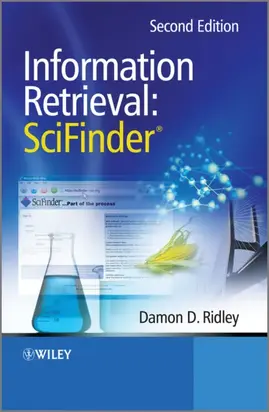
SciFinder® is rapidly becoming a preferred means to access scientific information in industry and universities worldwide. It accesses databases which span the chemical, engineering, life, medical, and physical sciences, including five Chemical Abstract Service databases and the National Library of Medicine bibliographic database Medline®. No other single information access tool has such breadth of coverage for scientific journal and patent documents. Information Retrieval: SciFinder®, 2nd Edition is an essential guide explaining how to get the best out of SciFinder. It discusses the 50+ options in SciFinder® including topic, bibliographic, and chemical substance explore options, and post-processing options Analyze, Refine, and Categorize. The book: Summarises the databases and explains how to take advantage of the unique search and analysis options Explains selected algorithms behind the operation of SciFinder® and why it helps to understand them Discusses why it is important, and how to apply scientific method to information retrieval Describes how to search for chemical structures and chemical reactions This second edition of Information Retrieval: SciFinder® has been fully revised and updated to incorporate the latest functionality and content of SciFinder®. Written by a scientist for scientists, this book will increase your research creativity and productivity and is an essential resource for anyone needing scientific information in academia or industry.

Жанр в блоке книги Зарубежная Деловая Литература
A hands-on tool for conducting the successful, profitable sale of a business As business owners gray, trends have shown that they start thinking of cashing out. Selling Your Business For Dummies gives readers expert tips on every aspect of selling a business, from establishing a realistic value to putting their business on the market to closing the deal. It helps them create sound exit plans, find and qualify, find and qualify a buyer, conduct a sale negotiation, and successfully transition the business to a new owner. The accompanying CD is packed with useful questionnaires, worksheets, and forms for prospective sellers, as well as a blueprint for customizing and assembling information into business sale presentation materials sale presentation materials –including snapshots of revenue and profit history, financial condition, market conditions, brand value, competitive arena, growth potential, confidentiality agreements, and other information that supports the sale price. Note: CD-ROM/DVD and other supplementary materials are not included as part of eBook file. Please refer to the book's Introduction section for instructions on how to download the companion files from the publisher's website.

10 Количество книг
2 Количество книг
1 Количество книг
