Назад

Nowotny Helga Скачать все книги 3 Количество книг

Жанр в блоке книги Сделай Сам
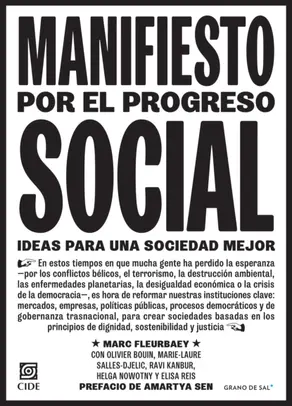
El progreso social puede verse como un objetivo a alcanzar o como una amenaza de la que conviene apartarse. En décadas recientes hemos atestiguado el declive de la pobreza mundial y el arribo de la democracia a numerosos países, la ampliación de programas de salud y educación, con innegables mejoras en la esperanza y la calidad de vida, pero a la vez reina una atmósfera de escepticismo sobre la posibilidad —y la conveniencia— de inducir un progreso social como el alcanzado por las sociedades más desarrolladas, con su cauda de desigualdad y sus costos ambientales. En busca de soluciones a los problemas globales, el Panel Internacional sobre Progreso Social reunió a más de 300 científicos sociales para que, con base en estudios novedosos, con una vocación multidisciplinaria y una mirada prospectiva, revisaran numerosas opciones de cambio social a largo plazo, exploraran los retos actuales y propusieran formas de mejorar las principales instituciones de las sociedades modernas. De ese trabajo colaborativo surge este manifiesto, en el que el ánimo utópico convive con el pragmatismo, en el que la búsqueda de justicia es compatible con el fortalecimiento de actores clave, como la empresa o el mercado. La conclusión es simple y a la vez entraña enormes complicaciones: sí es posible una sociedad mejor pero urge armonizar diversas fuerzas. Para lograr un cambio cultural de grandes proporciones, se requiere una audaz mezcla de idealismo y sensatez. Es lo que este manifiesto ofrece.

Жанр в блоке книги Социология

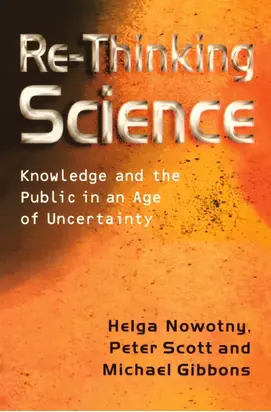
Re-Thinking Science presents an account of the dynamic relationship between society and science. Despite the mounting evidence of a much closer, interactive relationship between society and science, current debate still seems to turn on the need to maintain a 'line' to demarcate them. The view persists that there is a one-way communication flow from science to society – with scant attention given to the ways in which society communicates with science. The authors argue that changes in society now make such communications both more likely and more numerous, and that this is transforming science not only in its research practices and the institutions that support it but also deep in its epistemological core. To explain these changes, Nowotny, Scott and Gibbons have developed an open, dynamic framework for re-thinking science. The authors conclude that the line which formerly demarcated society from science is regularly transgressed and that the resulting closer interaction of science and society signals the emergence of a new kind of science: contextualized or context-sensitive science. The co-evolution between society and science requires a more or less complete re-thinking of the basis on which a new social contract between science and society might be constructed. In their discussion the authors present some of the elements that would comprise this new social contract.

Жанр в блоке книги Историческая Фантастика

Timest

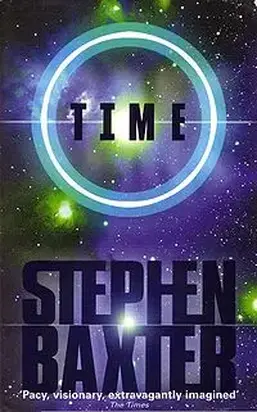
The book begins at the end of space and time, when the last descendants of humanity face an infinite but pointless existence. Due to proton decay the physical universe has collapsed, but some form of intelligence has survived by embedding itself into a lossless computing substrate where it can theoretically survive indefinitely. However, since there will never be new input, eventually all possible thoughts will be exhausted. Some portion of this intelligence decides that this should not have been the ultimate fate of the universe, and takes action to change the past, centering around the early 21 century. The changes come in several forms, including a message to Reid Malenfant, the appearance of super-intelligent children around the world, and the discovery of a mysterious gateway on asteroid 3753 Cruithne.

Популярные серии