

Weightman Gavin Скачать все книги 2 Количество книг




Жанр в блоке книги Культурология
The story of the 19th-century ice trade, in which ice from the lakes of New England – valued for its incredible purity – revolutionised domestic life around the world.In the days before artificial refrigeration, it was thought impossible to transport ice for long distances. But one man, Frederic Tudor, was convinced it could be done. This is the story of how, almost single-handedly, and in the face of near-universal mockery, he established a vast industry that would introduce the benefits of fresh ice to large parts of the globe.Thanks to Tudor, the American fashion for drinks ‘on the rocks’ spread to tropical areas such as the West Indies and British India. By the 1830s fleets of schooners carried the frozen cargo, packed with sawdust and tarpaulins for insulation, to all corners of the world. The harvesting of the ice from New England’s lakes employed thousands of men.The frozen water trade had a profound influence on the tastes of a large part of the world, but with the development of artificial cooling systems in the first quarter of the 20th century, the huge industry established by Frederic Tudor vanished as if it had never been.Note that it has not been possible to include the same picture content that appeared in the original print version.
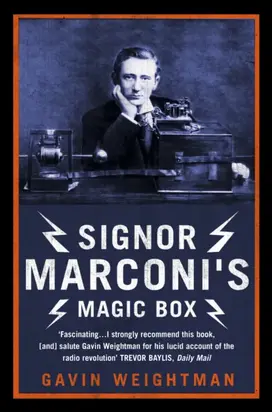
Жанр в блоке книги Биографии И Мемуары
The intriguing story of how wireless was invented by Guglielmo Marconi – and how it amused Queen Victoria, saved the lives of the Titanic survivors, tracked down criminals and began the radio revolution.Wireless was the most fabulous invention of the 19th century: the public thought it was magic, the popular newspapers regarded it as miraculous, and the leading scientists of the day (in Europe and America) could not understand how it worked. In 1897, when the first wireless station was established by Marconi in a few rooms of the Royal Needles Hotel on the Isle of Wight, nobody knew how far these invisible waves could travel through the ‘ether’, carrying Morse Coded messages decipherable at a receiving station. (The definitive answer was not discovered till the 1920s, by which time radio had become a sophisticated industry filling the airwaves with a cacaphony of sounds – most of it American.)Note that it has not been possible to include the same picture content that appeared in the original print version.Marconi himself was the son of an Italian father and an Irish mother (from the Jameson whiskey family); he grew up in Italy and was fluent in Italian and English, but it was in England that his invention first caught on. Marconi was in his early twenties at the time (he died in 1937). With the ‘new telegraphy’ came the real prospect of replacing the network of telegraphic cables that criss-crossed land and sea at colossal expense. Initially it was the great ships that benefited from the new invention – including the Titanic, whose survivors owed their lives to the wireless.

10 Количество книг
2 Количество книг
1 Количество книг
