

Stiegler Bernard Скачать все книги 3 Количество книг




Жанр в блоке книги Зарубежная Публицистика
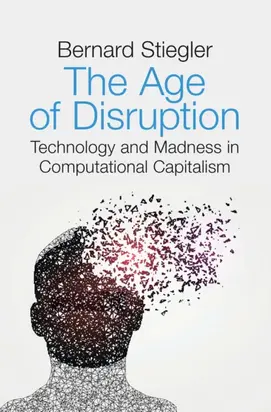
In the aftermath of the First World War, the poet Paul Valéry wrote of a ‘crisis of spirit’, brought about by the instrumentalization of knowledge and the destructive subordination of culture to profit. Recent events demonstrate all too clearly that that the stock of mind, or spirit, continues to fall. The economy is toxically organized around the pursuit of short-term gain, supported by an infantilizing, dumbed-down media. Advertising technologies make relentless demands on our attention, reducing us to idiotic beasts, no longer capable of living. Spiralling rates of mental illness show that the fragile life of the mind is at breaking point. Underlying these multiple symptoms is consumer capitalism, which systematically immiserates those whom it purports to liberate. Returning to Marx’s theory, Stiegler argues that consumerism marks a new stage in the history of proletarianization. It is no longer just labour that is exploited, pushed below the limits of subsistence, but the desire that is characteristic of human spirit. The cure to this malaise is to be found in what Stiegler calls a ‘pharmacology of the spirit’. Here, pharmacology has nothing to do with the chemical supplements developed by the pharmaceutical industry. The pharmakon, defined as both cure and poison, refers to the technical objects through which we open ourselves to new futures, and thereby create the spirit that makes us human. By reference to a range of figures, from Socrates, Simondon and Derrida to the child psychoanalyst Donald Winnicott, Stiegler shows that technics are both the cause of our suffering and also what makes life worth living.
Жанр в блоке книги Книги По Философии
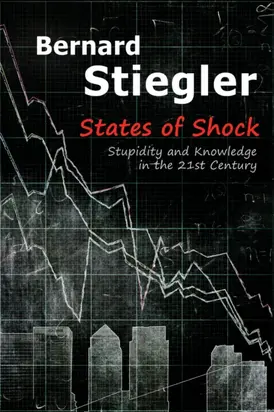
In 1944 Horkheimer and Adorno warned that industrial society turns reason into rationalization, and Polanyi warned of the dangers of the self-regulating market, but today, argues Stiegler, this regression of reason has led to societies dominated by unreason, stupidity and madness. However, philosophy in the second half of the twentieth century abandoned the critique of political economy, and poststructuralism left its heirs helpless and disarmed in face of the reign of stupidity and an economic crisis of global proportions. New theories and concepts are required today to think through these issues. The thinkers of poststructuralism Lyotard, Deleuze, Derrida must be re-read, as must the sources of their thought, Hegel and Marx. But we must also take account of Naomi Klein's critique of Milton Friedman and the Chicago School and her account of the 'shock doctrine'. In fact, argues Stiegler, a permanent 'state of shock' has prevailed since the beginning of the industrial revolution, intensified by the creative destruction brought about by the consumerist model. The result has been a capitalism that destroys desire and reason and in which every institution is undermined, above all those institutions that are the products par excellence of the Enlightenment the education system and universities. Through a powerful critique of thinkers from Marx to Derrida, Stiegler develops new conceptual weapons to fight this destruction. He argues that schools and universities must themselves be transformed: new educational institutions must be developed both to take account of the dangers of digitization and the internet and to enable us to take advantage of the new opportunities they make available.

10 Количество книг
2 Количество книг
1 Количество книг
