

A. Antonio Munjiza Скачать все книги 2 Количество книг


Жанр в блоке книги Техническая Литература
The combined finite discrete element method is a relatively new computational tool aimed at problems involving static and / or dynamic behaviour of systems involving a large number of solid deformable bodies. Such problems include fragmentation using explosives (e.g rock blasting), impacts, demolition (collapsing buildings), blast loads, digging and loading processes, and powder technology. The combined finite-discrete element method – a natural extension of both discrete and finite element methods – allows researchers to model problems involving the deformability of either one solid body, a large number of bodies, or a solid body which fragments (e.g. in rock blasting applications a more or less intact rock mass is transformed into a pile of solid rock fragments of different sizes, which interact with each other). The topic is gaining in importance, and is at the forefront of some of the current efforts in computational modeling of the failure of solids. * Accompanying source codes plus input and output files available on the Internet * Important applications such as mining engineering, rock blasting and petroleum engineering * Includes practical examples of applications areas Essential reading for postgraduates, researchers and software engineers working in mechanical engineering.
Жанр в блоке книги Математика
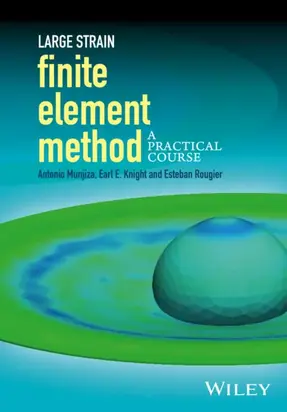
An introductory approach to the subject of large strains and large displacements in finite elements. Large Strain Finite Element Method: A Practical Course, takes an introductory approach to the subject of large strains and large displacements in finite elements and starts from the basic concepts of finite strain deformability, including finite rotations and finite displacements. The necessary elements of vector analysis and tensorial calculus on the lines of modern understanding of the concept of tensor will also be introduced. This book explains how tensors and vectors can be described using matrices and also introduces different stress and strain tensors. Building on these, step by step finite element techniques for both hyper and hypo-elastic approach will be considered. Material models including isotropic, unisotropic, plastic and viscoplastic materials will be independently discussed to facilitate clarity and ease of learning. Elements of transient dynamics will also be covered and key explicit and iterative solvers including the direct numerical integration, relaxation techniques and conjugate gradient method will also be explored. This book contains a large number of easy to follow illustrations, examples and source code details that facilitate both reading and understanding. Takes an introductory approach to the subject of large strains and large displacements in finite elements. No prior knowledge of the subject is required. Discusses computational methods and algorithms to tackle large strains and teaches the basic knowledge required to be able to critically gauge the results of computational models. Contains a large number of easy to follow illustrations, examples and source code details. Accompanied by a website hosting code examples.

6 Количество книг
2 Количество книг
2 Количество книг
